
Success · Sakété temple
Success spell: what a voodoo priest from Benin reads in a path that keeps closing, and how a way is opened at the temple
Talent, effort, good plans, and still the door closes every time: that is when people start looking for a success spell. At the Sakété temple, the request begins with the Fâ, consulted free of charge. The signs say what blocks the way, whether a work can open it, and which part of success remains in your own hands.
Filmed testimony
“I was skeptical at first, but I’m honestly so grateful I gave it a chance.”
A client, face shown, in her own words
The Fâ first
Success spell: what the Fâ asks before opening a way
People who write about success rarely lack ambition. They describe a promotion that went to someone else three years running, a business that never takes off, studies abandoned at the last step, an artistic career stuck at the door. Wêtê Agbonon asks them to describe the goal, what has been tried, and where things usually break, along with their name, birth date and a portrait.
The opèlè is then cast at Sakété. The answer may show a closed road that a vodun must open, an ancestor or a promise that holds the person back, envy around them, or simply a timing that is wrong and a strategy to rethink. It reaches them in writing, and costs nothing.
A Fâ reading, explained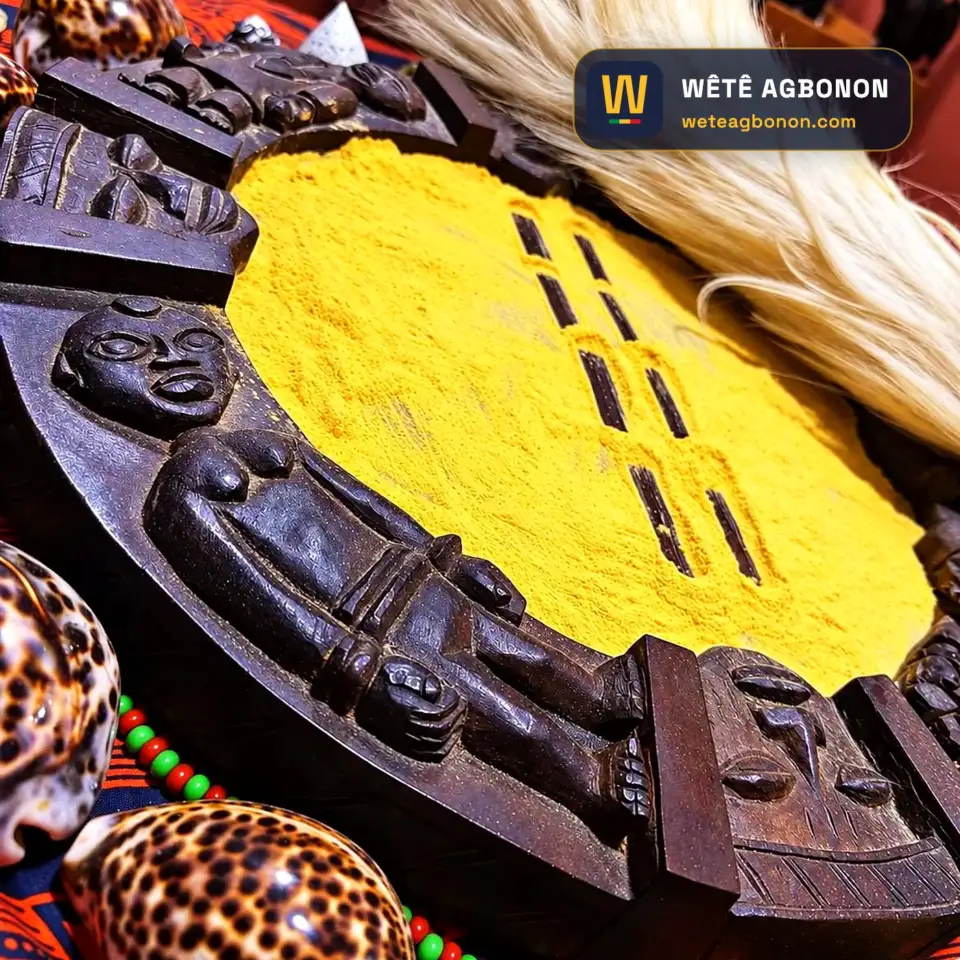
At a glance
The success spell in a few lines
- What people want
- A career that moves, a business that grows, studies completed, a project that finally lands.
- What the tradition says
- Each person has a destiny; roads can be opened, blocked or misread.
- What decides
- A Fâ reading, offered free, that names what stands in the way.
- What can be done
- Opening a road, settling a debt to the ancestors, protecting against envy, choosing the right moment.
- What he refuses
- Taking another person’s success, promising fame or a date.
Success spells, online and at the temple
Online, a success spell is sold as a shortcut: a candle, an oil, a chant, and the job offer arrives. Many traditions do have gestures for success, from the Chinese custom of honouring the god of literature before examinations to the European habit of carrying a lucky charm to an interview. They express a hope, and they can steady the nerves.
At a voodoo temple, the request is taken differently. Before any ritual, the Fâ is asked why success does not come. A spell for success, in this sense, is the work the signs prescribe once the obstacle is known, and nothing else.
Success spells around the world
The wish to tip the balance before a test is universal. Chinese students have long prayed to Wenchang, the god of literature, before examinations. Japanese shrines sell charms for exam success to candidates and their parents each winter. Hindu families honour Ganesha, the remover of obstacles, before starting a business or a course of study. Catholic students sometimes pray to Saint Joseph of Cupertino, patron of those taking exams.
These customs share a conviction: success is not only a matter of effort, it also depends on what opens or closes the way. The tradition of Benin agrees, and adds a step the others often skip, the reading that says what exactly blocks a particular person.
Destiny and the roads that open
In the tradition of Benin, every person comes into the world with a destiny, which the Fâ can reveal. Among the Fon, men initiated to the Fâ learn their kpoli, the sign that rules their path. That destiny describes strengths, dangers, prohibitions and favourable directions; each person can honour it or ignore it.
Legba, guardian of crossroads and messenger of the vodun, receives the first offering in every ceremony because he opens and closes the ways. When people say their road is blocked, the reading looks at that crossroads first: is a door closed by a vodun neglected, by an ancestor waiting for recognition, by someone who envies you, or by choices that pull against your own destiny?
When success is blocked by others
Envy is the oldest explanation for failure in many families, and sometimes it is accurate. A colleague who undermines you, a relative who speaks against you, a rival who resents a past success. The tradition adds that envy can take a spiritual form, a charge laid to make doors close in front of someone.
The Fâ settles whether this applies to you. When it does, the work at the temple lifts the charge and protects you. When it does not, the reading avoids a dangerous error: blaming the people around you for difficulties that have other causes.
Six situations
6 blocked paths that lead people to ask for a success spell
These requests arrive every week. The Fâ sorts, case by case, what is spiritual and what is practical.
The promotion that never comes
Good reviews, extra hours, and the post goes to someone else.
The business that stays small
Customers who come once, partners who leave, growth that stalls.
Studies left unfinished
A degree abandoned at the final year, an exam failed again and again.
The artist at the door
Auditions, submissions, near-misses that never become a break.
The migrant who cannot settle
Papers, work, housing: nothing stabilises years after arriving.
The last-minute collapse
Projects that fail just before signing, every time.
What the reading can show
Should the signs reveal a spiritual obstacle, they name it. A vodun of the family left without offerings, who withdraws protection. An ancestor whose memory was neglected, or whose land was sold. A prohibition attached to the person’s destiny, broken without knowing. A charge laid out of envy. A promise once made in exchange for a favour and never honoured.
The signs may also point to the person’s own direction: a path chosen to please others, a career that runs against what the Fâ shows as favourable, a timing that calls for patience. In those cases, the advice is practical, and sometimes it is the most valuable part of the reading.

How a success spell opens a way at the temple
A work for success is led by Wêtê Agbonon in person at Sakété, following the order the signs gave. Legba is greeted first; the vodun concerned receives the offerings named by the reading; the person’s name and goal are spoken before the altar. The reading decides the rest: lifting a charge, honouring an ancestor, or preparing a protection to accompany an exam, an interview, a launch.
The Fâ often gives instructions that are part of the work: a prohibition to respect during a period, a gesture before an important appointment, a person to reconcile with. You are told when the work starts and when it is complete.
When the moment matters
In Benin, people consult the Fâ before launching a business, signing a contract, setting out on a journey or marrying. The question is often less whether to act than when. A reading can show that a project is sound and the timing wrong, that a few weeks of patience or a preliminary offering will make the difference.
This is one of the most practical services a spell for success can offer: a clear indication of the right moment, and of the gestures that accompany it.
Signs your path may be blocked
Letters describe recurring patterns: failures that happen at the same stage every time, opportunities that vanish the moment they become concrete, people who promise help and then disappear, a sense of being watched or resented at work. Some describe dreams of closed doors or of walking without arriving.
None of these proves a spiritual obstacle. Repeated failure can come from a skill gap, a market, an employer, a habit. The reading exists to tell the difference, and to avoid both errors: dismissing a real blockage, or inventing one where there is none.
Success spells and hard work
No ritual writes a dissertation, closes a sale or learns a role in your place. People who combine the work of the temple with steady effort describe the clearest progress, and the Fâ itself usually insists on what depends on the person: training to finish, a network to build, a habit to drop. A success spell that promised to replace effort would be lying.
Practical support matters too. Career coaches, mentors, business advisers, tutors and professional associations exist in most cities, many of them free or low cost. A reading that tells you to persist is more useful when you know where to put your energy.
After the work
Once the work is complete, keep the instructions the Fâ gave and keep going: apply again, pitch again, sit the exam again. People often notice small openings first, an unexpected call, a contact who reappears, an interview that feels different. Write to the temple when the period set by the signs ends; a short update allows a second look if anything still holds the road shut.
Success that lasts
The tradition is wary of sudden, unexplained success. A fortune or a position obtained too fast, without the person growing into it, is said to be fragile. What the temple seeks is a road that opens and stays open: a career built step by step, a business with loyal customers, a qualification earned.
That is why a success spell at Sakété so often comes with advice about relationships, generosity and gratitude toward the ancestors. Success shared with family and community, the elders say, is protected by many hands; success hoarded attracts envy.
Taking someone else’s place
Some requests ask for success at another person’s expense: to make a rival fail an interview, to push a colleague out, to steal a client. Wêtê Agbonon refuses them all. The tradition warns that success built on harm does not last, and that it can turn against the one who asked for it.
What he can do is protect you against what others may be doing, and open the way that belongs to you.

What to put in your letter
Describe the goal precisely: the post you want, the business figures you need, the exam and its date, the audition. Explain what has happened so far, with dates: applications, interviews, launches, failures, and what people told you afterwards. Mention any conflict at work or in the family, any promise made by a relative, any ritual done elsewhere.
Add what you have already changed and what you are willing to change. A request for a success spell that comes with this kind of detail allows the Fâ to answer a real question, and allows Wêtê Agbonon to give advice that fits your own life.
Success spells for sale: warning signs
Beware of anyone who sells success by subscription, guarantees a promotion within a week, or asks for a share of your future earnings. Beware of the practitioner who finds a new blockage every time you are about to stop paying. Real work for success has a beginning, an end and a price stated once.
At Sakété, the reading is given freely. If the Fâ asks for a work, the reply states its price in one figure, valid for seven days, which can be spread over several payments; the work begins once it is paid. When the time indicated by the signs ends and nothing has moved, despite the instructions being followed, you may request a second performance within thirty days, and it costs nothing.
A case to imagine
Nobody in this case is real; it combines elements that letters often contain. A nurse in Birmingham has applied five times for a senior post on her ward. Each time she reaches the final interview and loses to a candidate with less experience. Her mother says the family has been blocked since a land quarrel in Benin twenty years ago.
The reading may confirm that the old quarrel left a closed road, to be opened at the temple with an offering to the family vodun and a protection for her next interview. It may also show that her application is the real obstacle, and advise her to ask the panel for feedback and to seek a mentor. Whatever the signs say, a written answer reaches her; a quote is attached only when the temple has work to do.
A consultation from wherever you are
Requests for a success spell reach the temple every day. The people who ask for a spell for success write from cities across Britain, North America, West Africa and Europe. They do not travel: the Fâ is read at Sakété using the details they provide, and the reply comes from Wêtê Agbonon himself, in English or French. At the start of 2026, France 24 interviewed him in six minutes of footage on mangrove forests made sacred, and the reviews page gathers accounts from people he has worked with.
Only the consultation is free. When the road keeps closing, it tells you whether something truly blocks it, and what you can open yourself.
Questions
Success spell: what people want to know
Do success spells work?
When the Fâ shows a blocked road, the temple can open it; the effort of reaching the goal remains yours.
What is a voodoo spell for success?
In Benin, a work decided by the Fâ: opening a road, honouring an ancestor, lifting a charge, or protecting a person before an important step.
Can a spell help me get promoted?
It can remove a spiritual obstacle when one exists. Promotions still depend on your work and your employer.
Can a success spell help with exams?
A protection can be prepared before an exam when the reading calls for it. Studying remains your part of the work.
Why does everything fail just before it succeeds?
Sometimes chance, sometimes strategy, sometimes a spiritual blockage. The reading tells which.
Can someone block my success with a spell?
Envy can take a spiritual form, the tradition holds. Whether it affects you is what the reading checks.
Will you make my rival fail?
No. Harming a rival is one of the requests the temple always turns down.
How long does a success spell take?
The signs fix the duration of each work, and it appears on the quote.
What does a reading cost?
Nothing at all; any work it calls for is quoted in writing first.
Do I need to be in Benin?
No. Works are done at Sakété with your name and goal spoken at the altar.
Who replies to my message?
Wêtê Agbonon personally, in English or French.
Do I have to share the faith?
Not at all. A clear account of your situation is enough for the reading.